4.7
607 Reviews
Flooring Arizona since 1945!
4.7/5


Professional Installation

Educated Consultants

4.7
607 Reviews
4.7/5

New countertops can transform a kitchen, but they are also a significant investment, and small missteps can lead to big regrets. Choosing countertops involves more than picking a color you like in the showroom. From edge profiles and seams to how a material handles hot pots and daily spills, the details matter. This guide digs into the most common countertop mistakes homeowners make, so you can sidestep them and end up with a surface you love for decades.
It is easy to fall for a small sample, but colors and patterns can look completely different across a full slab. Natural stone like granite countertops varies dramatically from piece to piece, with veining and movement that a two-inch chip cannot capture. Even quartz countertops can read differently in a large expanse than they do in a tiny swatch. Always view a large sample, in lighting similar to your kitchen. Showroom lighting is often brighter and cooler than the warm light at home, which can shift how a color feels once it is installed.
The prettiest countertop is the wrong one if it does not suit how you live. This is where many homeowners stumble. Quartz countertops are engineered, non-porous, and easy to clean, with excellent stain resistance and no sealing required, which makes them a favorite for busy families. Granite and other natural stone offer one-of-a-kind beauty and strong heat resistance but need periodic sealing to guard against stains. Solid surface counters are seamless and repairable but less heat tolerant. Butcher block brings warmth and character but demands regular oiling and care around water.
Understanding the maintenance needs of each material before you buy can help you choose a countertop that fits your routine. Match the countertop material to your cooking habits, not just your Pinterest board. For more guidance, see our complete guide to caring for and maintaining your countertops.
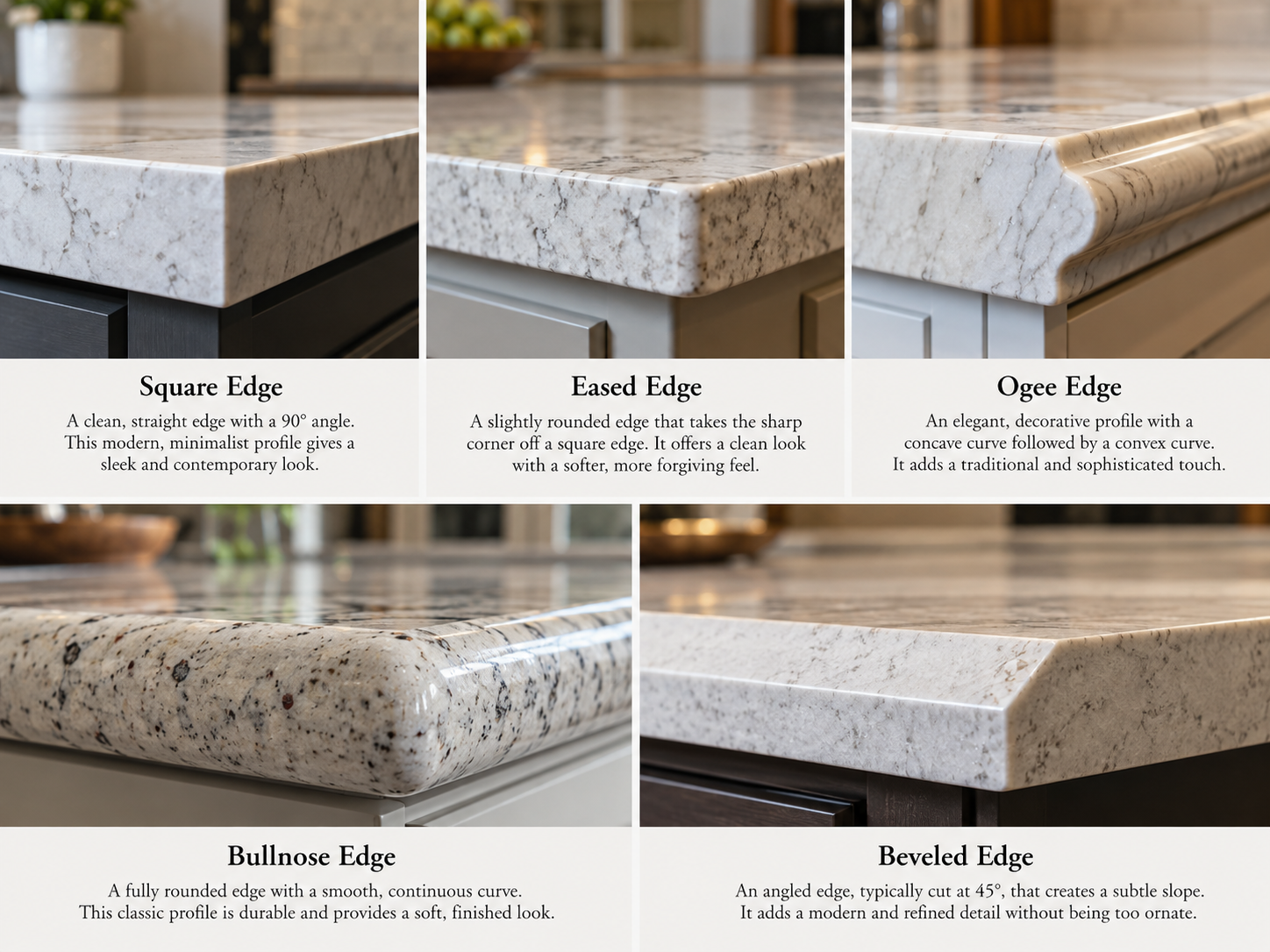
Edge profiles are one of the most overlooked details in choosing countertops, yet they shape both the look and the feel of your kitchen. A crisp square or eased edge feels modern and clean, while ogee, bullnose, and beveled edges add a more traditional, decorative touch. Beyond style, edges affect daily life: rounded profiles are gentler on hips and elbows and a bit safer around young kids, while sharp square edges can chip more easily on harder stones. Do not treat the edge as an afterthought. Look at samples in person and picture the profile running along your whole kitchen.
Almost every countertop longer than a slab will have seams, and pretending they do not exist is a classic error. On busy patterns, seams can practically disappear, while on solid colors or bold veining, a poorly placed seam stands out. A skilled fabricator plans seam locations strategically, keeping them away from focal points like the sink front where possible and matching veining across the joint. Ask where the seams will fall before installation day, and make sure your fabricator walks you through the layout so there are no surprises.
Assuming every countertop can shrug off anything is a costly mistake. Heat resistance varies widely by material. Granite and other natural stone handle heat well, but you should still use trivets to protect the sealer. Quartz, despite its toughness, can scorch or discolor if you set hot pots directly on it, so it always needs a trivet. Solid surface and butcher block are the least heat tolerant. Stain resistance differs too: sealed quartz resists stains beautifully, while unsealed natural stone can absorb oil and wine. Know your material's real limits so you can protect your investment from day one.
Even a perfect slab can be ruined by a poor install. Watching for these installation mistakes saves headaches:
The fix for nearly all of these is simple: use experienced, professional fabricators and installers rather than trying to save money with a DIY job or an inexperienced crew.
Beyond installation, a few kitchen countertop mistakes tend to surface only after you have lived with your counters for a while:
Start with how you actually use your kitchen. Consider maintenance, heat resistance, stain resistance, and durability alongside looks. Then factor in edge profiles, seam placement, and how a full slab appears in your lighting. Matching the countertop material to your lifestyle prevents the most common and costly regrets.
Quartz countertops are among the easiest to maintain. Because they are engineered and non-porous, they resist stains, never need sealing, and are simple to clean with soap and water.
It depends on the material, but the safe answer is no. Granite and natural stone tolerate heat well yet should still be protected to preserve the sealer. Quartz, solid surface, and butcher block can all scorch or discolor from direct heat. Always use trivets or hot pads to be safe.
You cannot always eliminate seams, but a skilled fabricator can make them nearly invisible. This means planning seam placement away from focal points, matching veining across the joint, and using color-matched adhesive. Busy patterns hide seams better than solid colors, so discuss the layout before installation.
Absolutely. Heavy stone slabs require precise templating, level support, careful cutout reinforcement, and expert seam work. Professional installers have the tools and experience to prevent cracks, gaps, and mismatched seams. Given the cost of the material, professional fabrication and installation protect your investment and your peace of mind.
Choosing countertops is a decision you will live with for years, so it pays to slow down and get the details right, from colour and edge profiles to seams and maintenance. Avoid the common mistakes above, be honest about how you cook and clean, and lean on experts who can guide you. When you are ready, visit a Baker Bros showroom to compare materials in person, explore your options, and get guidance from their design team on your countertop project.
Reviewed By: Phil Koufidakis, President at Baker Bros Area Rugs and Flooring
Phil Koufidakis has spent more than 25 years helping Arizona homeowners find the right flooring for their homes. As President of Baker Bros Area Rugs and Flooring, he brings decades of hands-on experience and industry knowledge.
Stay informed, get inspired, and be the first to know about promotions – subscribe now!
By subscribing, you agree to our Privacy Policy.